Greetings from the road!
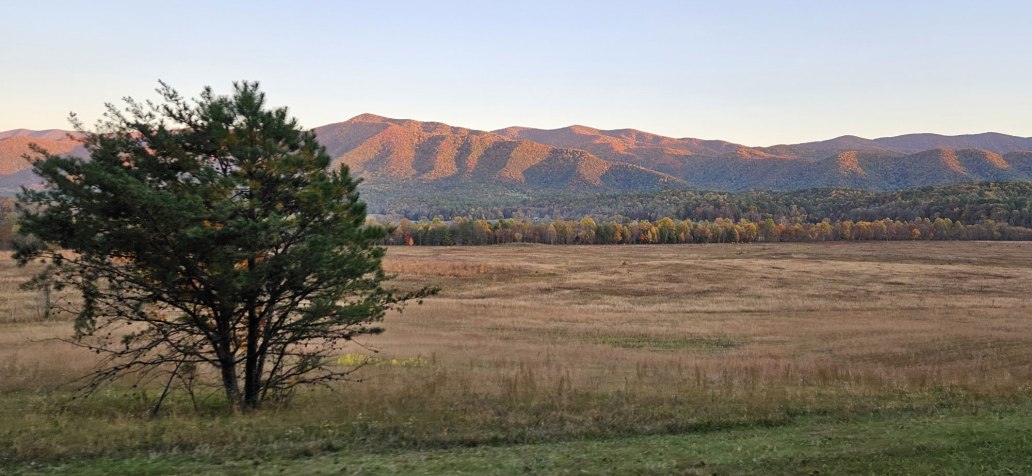
Writing to you from the Great Smoky Mountains which are, so far, smoky. Until I go to take a picture…
In my nomad journeys, I often joke about being a crime-fighting vagabond like Kade Black. Sure, there was that one time I had to track down my stolen Jeep. But I prefer my adventures to happen far from civilization without all the complications of society.
(I realize that doesn’t help my argument about not being a living trope. Trying to “live my hermit life but keep getting pulled back in…” is on that Bingo card somewhere…)
My personal mottos don’t involve retribution or revenge. Those are great fuel for exciting stories. But they’re fiction, just like Kade.
I stick to simple principles like leaving a place better than I found it. My campsite. My community. Hell, the planet.
When I’m on the road, I try to find ways to help. I’ve put in hundreds of hours as a volunteer in national parks, wildlife refuges, and national forests. These public lands have given me so much peace and tranquility, I want to pay it back somehow.
Our first year out, I volunteered to help the hurricane Michael recovery efforts. This year, I did the same for victims of Helene.
I don’t mention this to stroke my ego. I’m just one of hundreds, likely thousands of people giving a hand. Many are volunteers from surrounding communities. Others, like me, have travelled from across the country.
I’ve put in three days volunteering so far. It’s nothing sexy. I’m not rescuing people from flooded homes or digging out victims. Those harrowing early days are thankfully over. Nearly a month on, the disaster has changed but it has not gone away.
We’re in Tennessee in the foothills of the Smoky Mountains. About an hour east is Asheville, North Carolina where floodwaters nearly erased a community. The situation there has stabilized, but given the terrain, there are hundreds of families in remote, hard to reach places along the North Carolina Tennessee border who still need help.
The response has been a combination of local, state, federal, and private efforts. At this point, the goal for many is to clean up and rebuild. But I kept hearing about families on the “front lines” who must prepare to face the oncoming winter with nothing.
I don’t know the full count. I’m not sure there is one. Asheville already had a homeless population of 200. Another 500 people are living in county temporary shelters. Vouchers and funds have been given for motels and rent but with the area so severely impacted, not everyone will be able to take advantage of those.
So far, my work has mostly included sorting donations at distribution centers. Food, clothing, household goods. These are then either handed out directly to folks who can reach them or loaded up and hauled to those who can’t.
Yesterday I spent time sorting through tents to find the largest ones. Four to six person shelters along with below 30 degree rated sleeping bags. These were for families who will likely not have a permanent housing solution prior to winter.
Fortunately, many homes did survive. But the city streets haven’t yet been made safe. Debris is piled high on the curbs waiting to be picked up. Basic infrastructure like water treatment plants and private wells have been contaminated. Both main and back up power lines were swept away.
The efforts will be ongoing for the foreseeable future. Then the next disaster will strike and thousands more will rush to help.
People like Casey and Marta and Tom. Or the owner of the coffee shop who volunteered her space as a command center. Or property manager of the empty grocery store reincarnated as a food pantry and supply depot. And the dozens of community and church groups I saw manning the larger distribution center in Newport, Tennessee forty miles outside the Asheville disaster zone.
I guess what I’m trying to say is anybody can be a hero. Anybody can choose to help. Anybody can choose to tune out the noise and search for the best way to aid in a time of need.
You don’t need to be an action hero. Even Kade knows when the MPL-50 needs to just be a shovel. Sure, that doesn’t make for the most exciting story. But in the real world, cleaning up the aftermath and getting things back normal – making the victims whole – that’s the most important work any hero can do.
Stay safe everyone!
Russ
 RUSS LINTON
Leave a comment